Visar inlägg med etikett Science. Visa alla inlägg
Visar inlägg med etikett Science. Visa alla inlägg
söndag 27 februari 2011

Hot and cold water
What will happen when you put a bottle of hot colored water in a container filled with cold water?
lördag 19 februari 2011
Invertebrates results
The paintings as grade 6 made by invertebrates are finished :) They are fantastic! It was really a fun task. With simple materials such as pieces of cloth, yarn, papier mache, and a lot of gluing they made this beautiful animals. Look and enjoy!

Molluscs
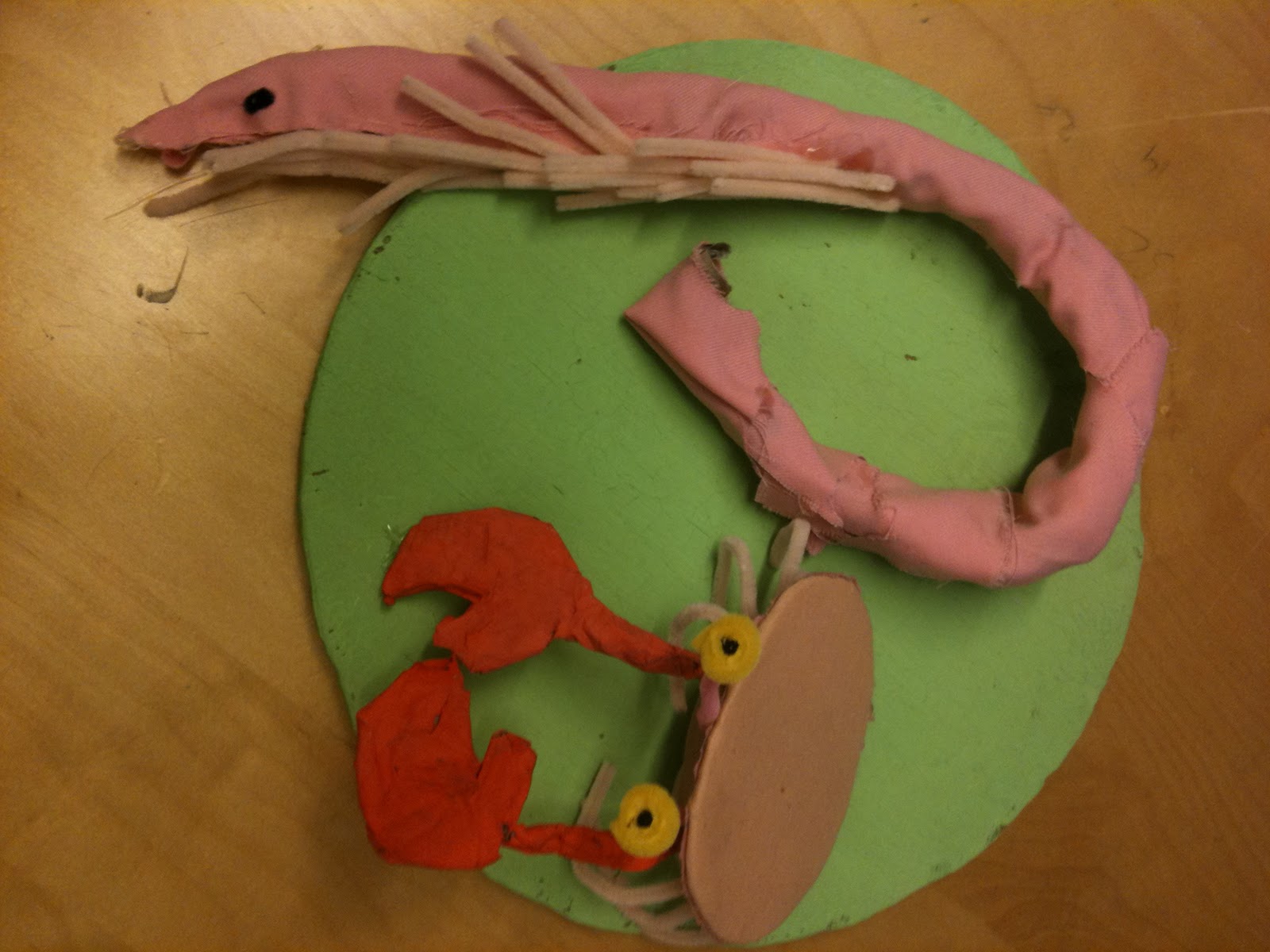
Crustaceans

Worms

Echinoderms


They are large circled paintings filled with animals who will decorate an entire wall at the school.
These are then hopefully for educational purposes especially for the younger students.
I am so proud of all the fine contributions!
Colored light
Grade 7 is working with salts and experimented today with colors when various salts, such as lithium chloride are on fire. To start fire we used methanol.


Beautiful!
Invertebrates
In grade 6, we work with invertebrates and in this task we are trying to get into the technology. Therefore, we all build all an animal from any of the groups of animals.
I think the result will be fantastic and look forward to the show. We have a lot of plans!


I think the result will be fantastic and look forward to the show. We have a lot of plans!

We´re using papier mache.

Some did the finger crochet.

Others were sewing.

Robins jellyfish begins to take shape.


Ellen makes the foundations of a starfish.

Victor and others were asked to make the paintings to put up the animals on.

Viktor is painting his centipede.
To be continued...
Magic
Today we made a fun and magical experiment. We tried it last week but did not succeed very well, but after some expert advice from Hans Persson we dared to try again. Shame not to give up!
 What did we do?


Patrick poured baking soda and vinegar in a jug.

Paulina "poured" over a glass. No liquid may come down. Hocus pocus!

Then Johan turns out the light with "nothing".
Salt and water
We are working with solutions and mixtures. Today we talked about the difference between a solution and a mixture. We added sugar in hot and cold water and drew atoms and ions.
Then the class had to find out if you can resolve how much salt as possible in a glass of water.


Then the class had to find out if you can resolve how much salt as possible in a glass of water.

Lucas and Samuel mixed with salt until they get a saturated solution.
We then used the salt solution to paint on black paper and came up with fine artwork.

Acid rain
Today we talked about how acid rain occurs and what the effects of the wild are and what we can do to improve the environment in the future. We made a small scene to show how acid rain arises and ends up in lakes and forests.
 We also did a theater of this, where Johan talks about how acid rain is formed and ends up in lakes. Emils mission was to save the lake and so he did by pouring chalk into the lake, to set up a bass. "Save the Lake" is what Hans Persson called the exercise in his book "Experiments with chemistry."
A super fun conclusion to the lesson and no one will forget what acid rain does:)
http://www.youtube.com/watch?v=awOiG8QWn3U&feature=player_embedded#

A super fun conclusion to the lesson and no one will forget what acid rain does:)
http://www.youtube.com/watch?v=awOiG8QWn3U&feature=player_embedded#
Chemical symbols
We looked at the new chemical symbols in Europe from 2010. We compared with the old symbols and talked about each symbol. Then the students made those symbol. They were super nice!


Joanna's fearsome symbol of toxic.
söndag 29 november 2009
Dramatize an electric engine
The electric engine that we built we then dramatized together. Here´s a series of images:


A coil

An electromagnet. She stands on a battery ( one paper with a + marked on it and one paper with a - marked on it)

We added two magnets.
And then what happened? Take a look!
We´ve got an electric engine.
Electric engine
Last Thursday we built an electric engine. We followed the description in Hans Persson's book "Reactions"

Here´s some of the results:
Julia and Caroline succeeded.

Linnea and Fanny is trying to work it out.
Emil and Johan made it too.
lördag 21 november 2009
Solid or liquid?
We have over a period worked extensively laboratory and we talked about the substance in different physical state. As a fun end I showed the class a little experiment.
Mix corn starch or potato starch in some water and try to figure out if it is in solid or liquid form.

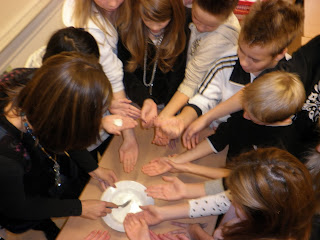
Mix corn starch or potato starch in some water and try to figure out if it is in solid or liquid form.

The children became very enthusiastic and appreciated the experiment. I think many of them also have shown their new "party trick" at home.


Experiments with a softdrink bottle
We did three different experiments with a softdrink bottle.
 Here is Sofia, Ella and Victoria. They put a piece of plastic at the top of an empty bottle and put down the bottle in warm water to see what happens. They succeeded! The piece of plastic started to tremble.
 Markus and Fredrik put a balloon on an empty bottle and put it in the warm water. It was exciting! The balloon inflated.
 Together, we found out what happens when you mix vinegar and baking soda. We poured some vinegar (we used a variant containing 24% acetic acid) in a bottle. Then we put baking soda in a balloon, which came on the bottle. When the baking soda fell into the vinegar, carbon dioxide was formed and the balloon was inflated.


Water
We're talking about water and doing various experiments. Look how fun it can be to learn the water chemical characters H2O. Just write a big H on each hand and open your mouth wide as an O.


Bucket
In 6th grade on Vibyskolan you start with half class in particular NO. Students are then ready to enter the exciting NO-room and experiment "for real" for the first time. In order to generate interest and inspire the students I do many experiments and practical work in various ways. I educate myself on professional education for teachers this year and was inspired by my great teachers of the course, Hans Persson and Margareta Forsbäck. Many of the experiments which I will show here on my blog is just ideas from these two stars. Here for example I introduce Hasses experiment "bucket" where I built up a magic box with a little trick and it make colored water colorless. Colored water that is poured into the bucket comes out of the spout on the side without color. Where did the color go? The challenge for students was to figure out how this could be possible. How does it look inside the bucket? Think about it!

In september I went with my class to Cygnaeus school in Turku. I brought my "bucket" and had Samuel, Johan and Arvid to do the experiment for students in Finland. Here's how it looked!

Prenumerera på:
Kommentarer (Atom)