Visar inlägg med etikett Hands on. Visa alla inlägg

lördag 19 februari 2011

Circumference/diameter

Today we went out. After a task in Hasse Perssons book "Experiments with Mathematics", we practically learned how we are dividing the circumference of a circle with its diameter to get Pi. We did this by using a stick and a rope. Students were placed along the rope and had to count there steps in a full circle.Then they walked the distance to the pin, the radius. The radius we then doubled to obtain the diameter of the circle. When we met up in the classroom again and reflected and discussed, we were dividing the circumference by the value of the diameter and we all got the answer 3. 


We got this great practice outside!

PI

With the help of three hockey pucks and some string, you can prove the value of Pi. We did this by measuring the circumference of the puck with the help of a string.
Linn was assisting.

Linn placed the string over a number of pucks and clearly saw that the circumference of the hockey puck was the same as the diameter of three pucks and a bit more ...

The idea for this lab component comes from Hasse Persons book "Experiments with mathematics".

It is of course possible to use mouse pads, glass, rock rings or any other round object to this evidence. The circumference corresponds always a bit more than three diameters. 3,14 .................

Build a fish

A while ago I met Hans Persson and he gave me the idea to build a fish. Me and my class took the bait :) on and I was so happy and proud of the class results. Look and enjoy! 

 A perch
Evan an octopus was made.
A bream
 A cod
A mackerel

The tower

Today we used multilink cubes for solving problems. How many cubes are there in this tower?

When it became more and more difficult we came up with the conclusion that the tower did not have to be all built because it was symmetrical. We discussed ways to solve the same problem and learned from each other. 

We also had time for a little humor! Olivia did some nice goggles :)

Play with angles

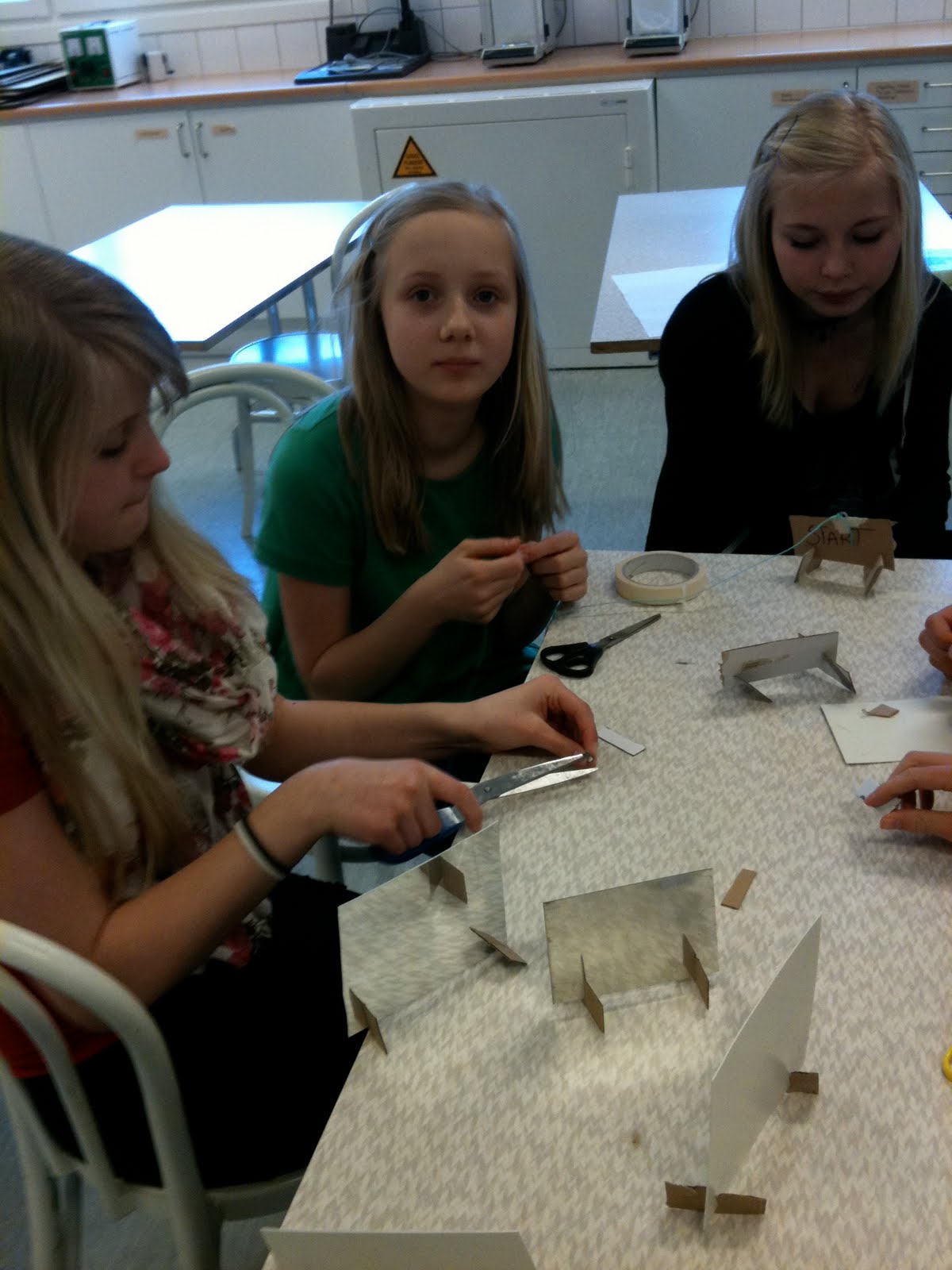
In Hans Perssons book "Experiments with mathematics" there are a task called Play with angles and we did that today. The mission is to build a path through all the mirrors so that the beam from a laser pen can get from start to finish. 
It was a fun task, and this group got all the way from start to finish.
One challenge was to design something that could hold the mirror straight up, otherwise the beam went up at the ceiling or down at the floor.
Linnea was very focused when she got on her thinking mustache:)

Chemical symbols

We looked at the new chemical symbols in Europe from 2010. We compared with the old symbols and talked about each symbol. Then the students made those symbol. They were super nice! 

Joanna's fearsome symbol of toxic.

tisdag 19 januari 2010

Fun charts

Welcome back! 
A new semester with lots of fun are waiting ahead.

My students are very creative and this week we are making charts in a different way. They were all asking at least 50 individuals a question, for example "What is your favourite season?" Then they present the result in a chart, like this:
Do you like pizza?

Favourite season? A knitted one!

Favourite sport in a box


Bad habbits in your home?

Favourite country, with famous buildings and people.

Were do you like to travel to?

Concentration

A lot of small pieces...

Hanna did a handmade decoration around the circle.

What is your favourite soda?

Favourite season?

I am very happy about the results and we are having a lots of fun, classroom fun!

tisdag 24 november 2009

Geometric ABC

We have made an abc of geometry, a large painting (70 cm * 100 cm) with small squares. Each square demonstrates a word that has to do with geometry, like Hypotenuse or Rectangle. It is of course in Swedish but I would like to show this great idea of mine. Enjoy!


We can take a closer look at some of the squares.


lördag 21 november 2009

Magnets

We are no learning about magnets. In Hans Persson's "Book of Physics and Chemistry", there is a task were you can build obstacle courses that are run with the help of magnets. Using cardboard, the children built ramps and fun figures to run with. The figures are attached to a paper clip and can be run from start to finish using a magnet held under the track. The children had so much fun that some did not even want to go to recess. Here are some of the results:


Last week we had a practical test. Again, it was Hans Persson and his books that inspired me. They got 3 small magnets of various kinds, and they should then answer the question "Which magnet is the best?" It was up to the children to interpret the question (the best at what?) and preparing tests to decide.


Joanna and Julia wanted to test the magnetic strength by starting with an empty container (they used a pencil pouch) and then fill it gradually. A good idea!


Amanda and Matilda raced the magnets against each other on the whiteboard. They attached a small weight (my keys) to the magnet. They then measured the time it took each magnet to slide down the whiteboard.


Another test was to find out how many paper clips a magnet can pull up from a glass of water.


A popular test was to see how many paper clips a magnet could hold hanging in a chain.


We also constructed an electromagnet. First, we concluded that a large iron nail was not magnetic. Then we wrapped it in copper wire and connected it to a 4.5 V battery. As long as the battery stayed connected the nail worked as a magnet and we could use it to lift up some smaller nails.

Weight - with wrapped milk cartons

Margareta Forsbäck told me how to work with wrapped milk cartons to introduce the concept of weight. Each carton could be filled with anything and was wrapped in neatly. At first the children were to sort the cartons by weight, then guess the weight and then check the weight to finally figure out the difference between hypothesis and results.

I then got an idea to try to balance the cartons on a self-made balance scale. We put the cartons on the balancescale trying to find balance. Two at a time we put them on the scale. We managed to put all the cartons on the scale without losing the balance. We then decided  to remove the cartons, also two at a time and still without losing the balance. It became more difficult but we made it.

Here's what it looked like:


The scale with Bratz and Barbie dolls

How could a Bratz doll or Barbie look like life-size? We found out.


How about it? Is it reasonable?


On the students' own initiative, we also thougt about how a doll really should look like and drew pictures of ourselves in the scale. It looked like this: